Sovereign AI: what an enterprise should actually control
Data residency is where sovereignty starts, not where it ends. This article defines sovereign AI for the enterprise as control over five layers, explains why the real measure is the cost of leaving, and names the three assets that keep that cost low.
An enterprise has done everything its compliance team asked. Its AI runs in an approved region, its data never leaves the country, and every contract has the right clauses. Then a notice arrives: the model its main workflow depends on will be retired in ninety days.
Nothing about data residency was breached. Yet the organization is about to lose control of the one thing that determines how its AI behaves. Answers will change, reviews will need to be repeated, and the timetable is set by someone else.
This is why the conversation about sovereign AI is shifting. Data residency is where sovereignty starts, not where it ends.
Five layers of control
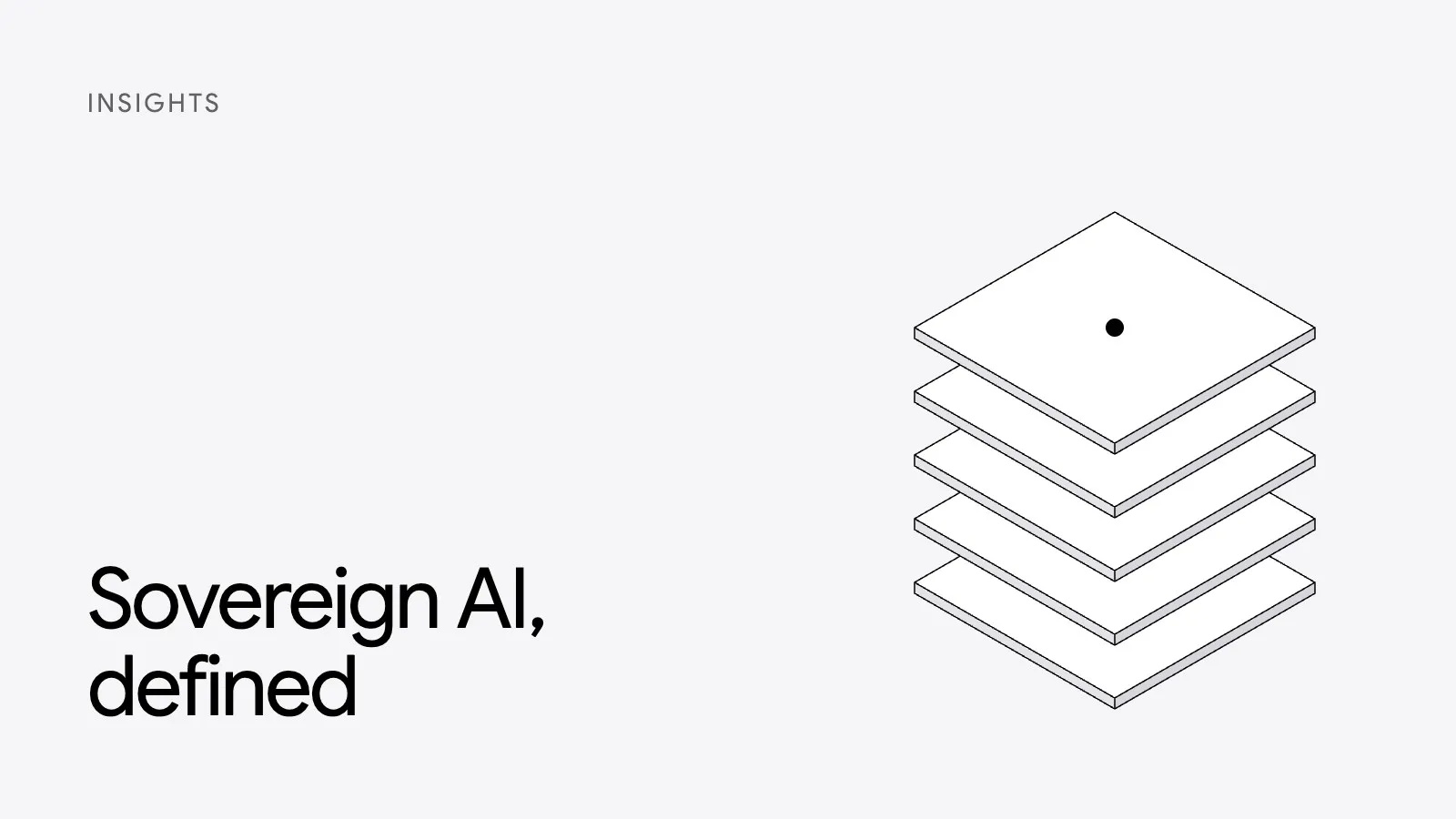
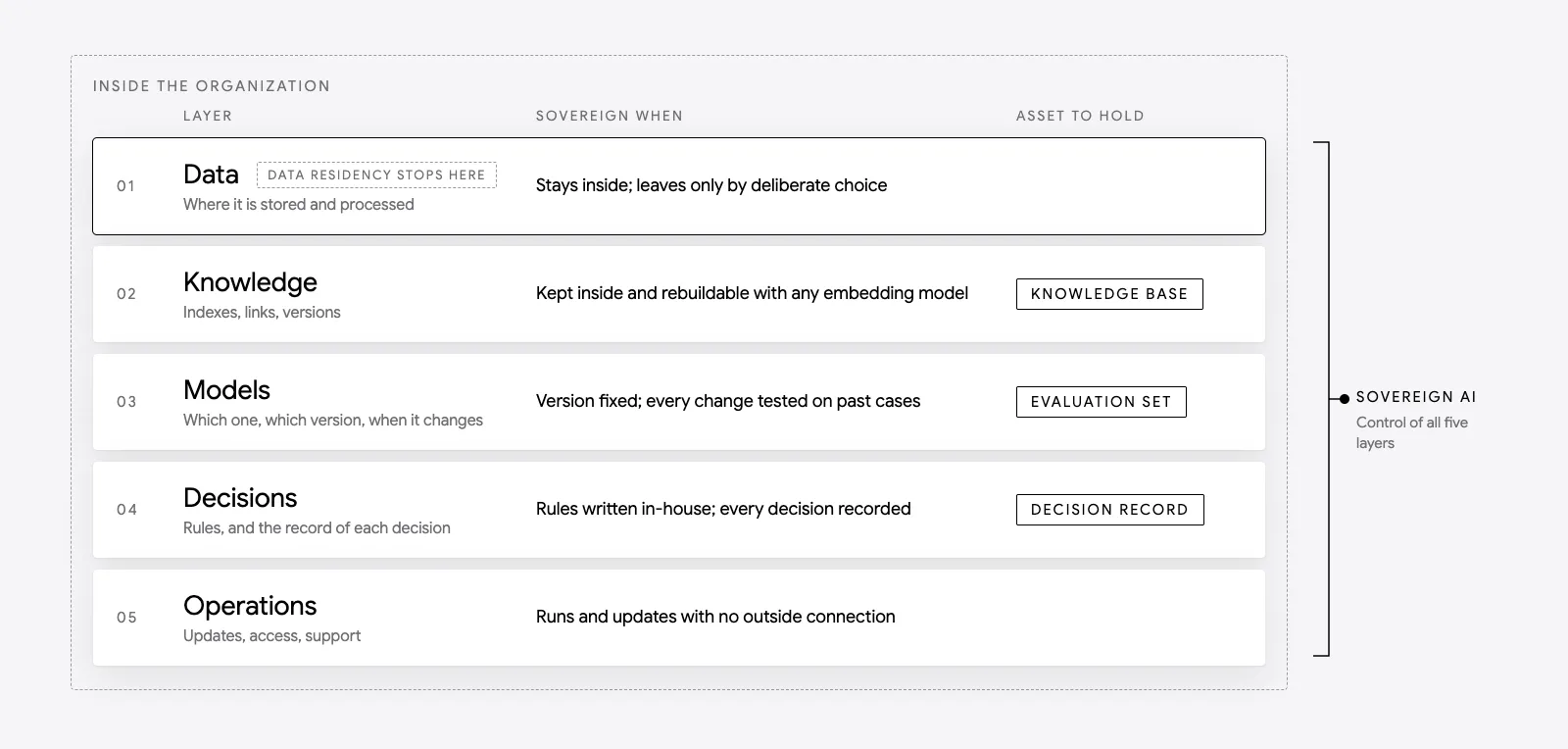
Residency answers one question: where is the data stored and processed? Sovereignty asks a broader one: who controls how AI works on that data, how it changes, and what it leaves behind. For an enterprise, the answer covers five layers.
| Layer | The question to ask |
|---|---|
| Data | Where is data stored and processed, and can it leave? |
| Knowledge | Who holds the knowledge built from that data: the indexes, links and versions? |
| Models | Who decides which model runs, which version, and when it changes? |
| Decisions | Who defines the rules, and where is the record of each decision kept? |
| Operations | Who controls updates, access and support? |
Most enterprises today are sovereign on the first layer and dependent on the other four.
Owning the data is not owning the knowledge
The knowledge layer is the one most often overlooked, and the reason is technical. To let AI search documents by meaning, a system converts every passage into a long list of numbers, called an embedding, using a particular embedding model. Those numbers only make sense to the model that produced them.
The consequence is easy to miss. An organization can hold every original document and still be unable to use its AI knowledge base anywhere else. Changing the embedding model means processing the entire collection again. Add the links between documents, the version history and the corrections reviewers have made over months, and the knowledge built on top of the data becomes an asset in its own right, often more valuable than any single file.
Sovereign AI treats that knowledge as enterprise property: kept inside the organization, and rebuildable there with its own models.
A model change is a change to every decision
When a document changes, one answer changes. When a model changes, every answer can change. A new version may phrase things differently, weigh evidence differently, or follow rules more or less strictly, across every case at once.
That is why model choice is not a procurement detail. An organization that cannot decide when its model changes cannot guarantee that today’s decision would be made the same way tomorrow. Sovereignty here means two things: fixing the version in production, and testing every proposed change against past cases before it goes live.
Sovereignty is measured by the cost of leaving
The most useful test of sovereignty is not where data is stored. It is how much it would cost to leave: to change provider, model or hosting, and keep working.
Regulation is beginning to ask the same question. In the European Union, the Digital Operational Resilience Act already requires financial institutions to maintain exit strategies for critical technology providers. As AI moves into core operations, the same expectation will reach AI systems: show that the organization could continue without any single supplier.
Three assets that keep the cost of leaving low
Three assets, held by the organization, make an exit possible rather than theoretical.
- The knowledge base, with its links, versions and corrections, stored internally and rebuildable with any embedding model.
- The evaluation set: a collection of past cases with known correct outcomes. It is the most portable asset an AI program has, because it can test any model, from any provider, against the organization’s own standard. It is also the most often neglected.
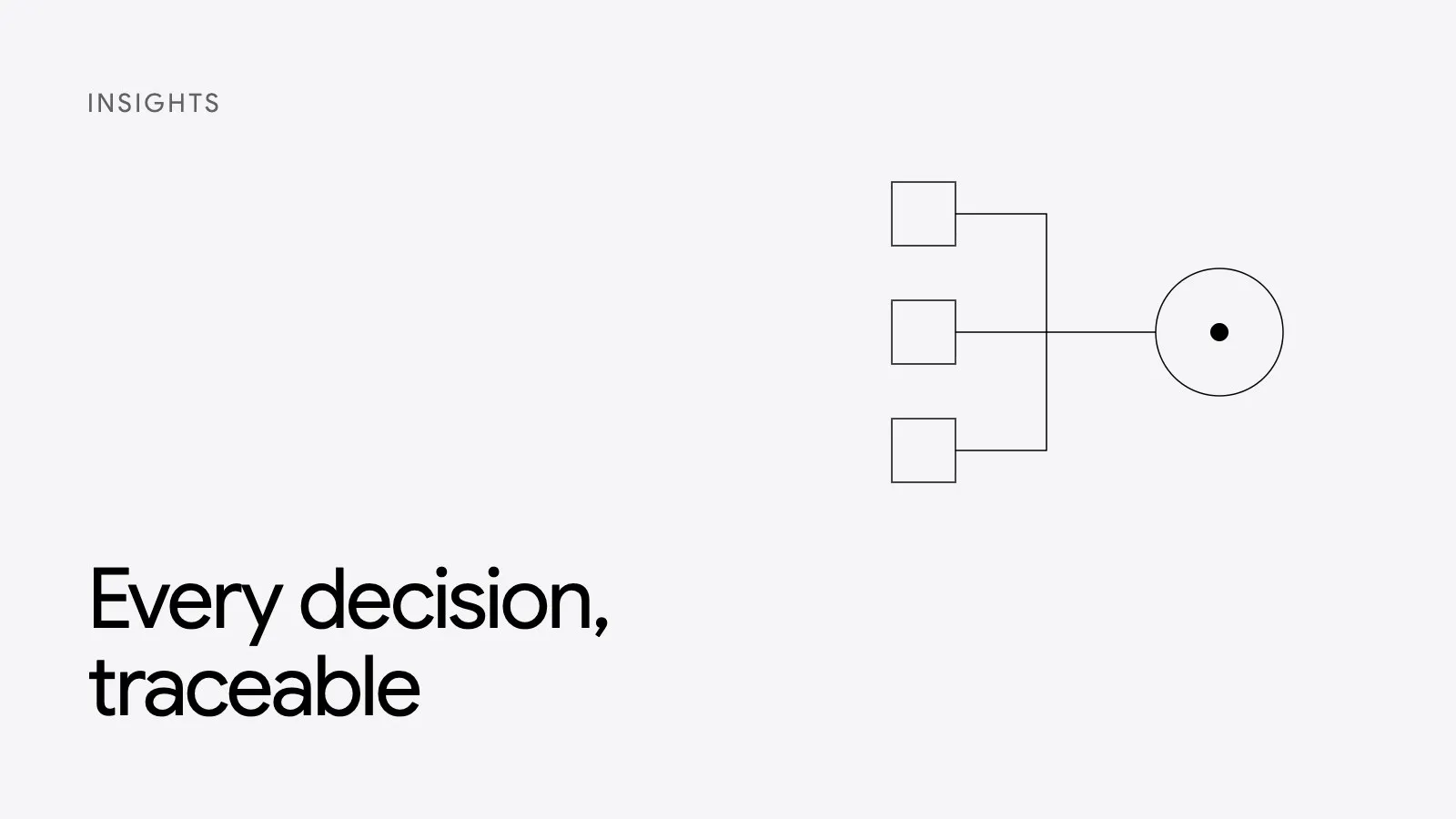
- The decision record: every past decision with its evidence, rules and review, kept in-house, so that accountability does not depend on a provider’s logs.
An organization that holds these three can change almost anything else. One that does not is dependent, wherever its data happens to be stored.
Sovereignty is not isolation
A sovereign approach does not mean rejecting the cloud or building everything in-house. Many organizations run sensitive work on-premises and less sensitive work in a cloud of their choice. What matters is that the organization draws the boundary for each workload, knows what each dependency would cost to unwind, and can redraw the boundary later.
How NU Tech approaches it
AxP, our AI Transformation (AX) Platform, is designed as a sovereign AI harness. It runs on-premises, hybrid or fully air-gapped. Dudl keeps the knowledge base, its versions and its links inside the organization’s infrastructure. Models are chosen by the customer and fixed by version, and every update is validated against past cases before release. N-Sight records each decision with its evidence and rules, in-house. (More on how AxP runs inside the organization’s own walls.)
To discuss what sovereign AI looks like for a specific organization, talk to our team.