Why enterprise AI is moving on-premises
The most valuable enterprise data is also the data that can't leave. Here's why more organizations are bringing AI to their data instead of sending data to AI — and what to look for when they do.
The first wave of enterprise AI ran in the public cloud. It was the fastest way to start: send a document to a hosted model, get an answer back. For drafting emails and summarizing public information, that still works well.
But for the work enterprises care about most, progress often stopped at the pilot. The reason is rarely the model. It is the data.
The data that matters most can’t move
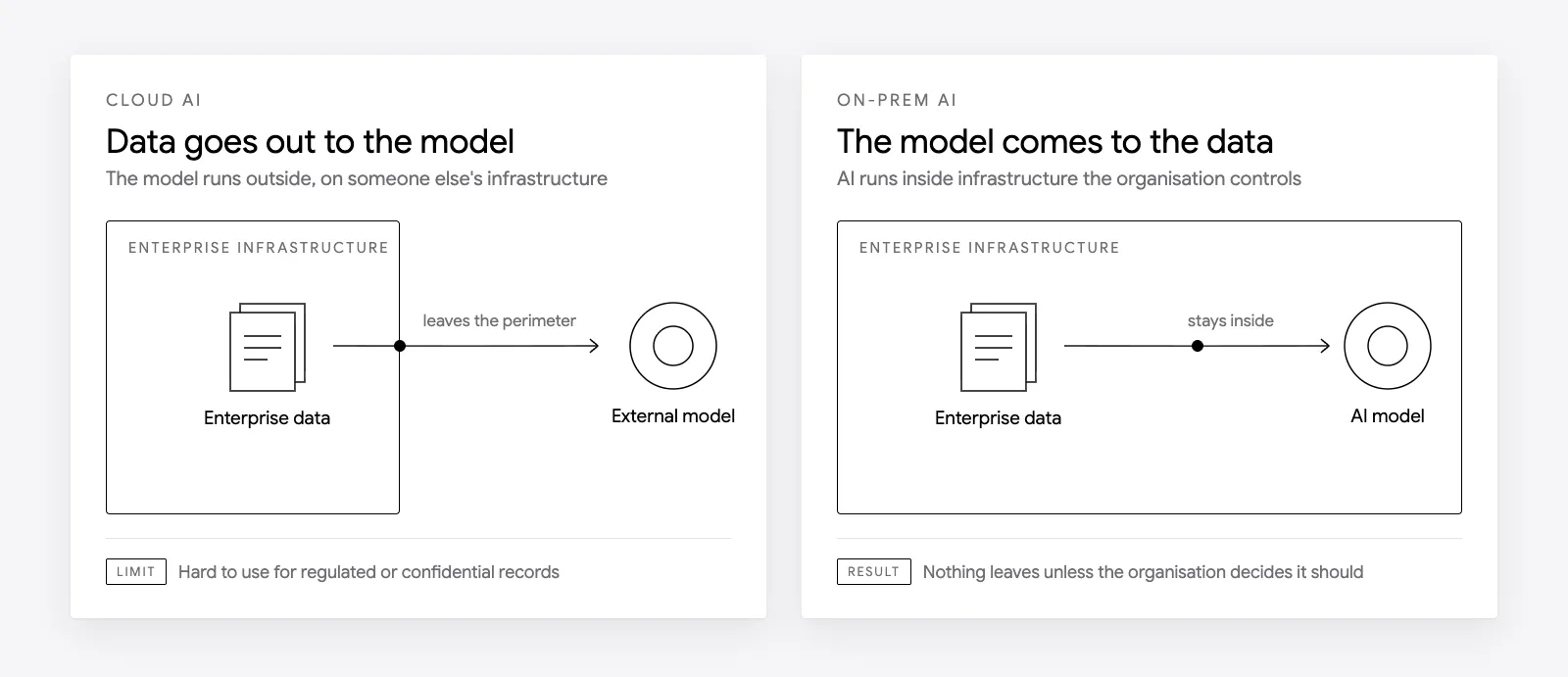
Consider where AI would help most in a large organization: reviewing insurance claims, checking contracts against policy, reading maintenance logs, answering questions from case files and patient records. These are exactly the records that are hardest to send outside:
- Regulation. Data-protection and sector rules limit where personal and regulated data may be processed, and many require organizations to show where it went.
- Contracts and confidentiality. Client agreements, trade secrets and internal legal material often may not be shared with a third party at all.
- Security policy. Many organizations simply do not allow their core systems to call out to an external service.
The result is a gap: AI is available, but not for the data where it would make the biggest difference.
Bring the model to the data
On-premises AI closes that gap by reversing the direction. Instead of sending data to a model, the model runs inside infrastructure the organization already controls — its own data center or private cloud — next to the data. Nothing leaves unless the organization decides it should.
Three deployment models cover most needs:
| Where the AI runs | Data leaves? | Fits | |
|---|---|---|---|
| On-Prem | The organization’s own data center | Never | Regulated and confidential records |
| Hybrid | Sensitive work local; the rest in a private cloud | Only what is chosen | Mixed workloads, gradual rollout |
| Air-gapped | A network with no outside connection | Never — there is no route out | Defense, critical infrastructure, the most restricted environments |
What changes when AI runs next to the data
Moving the model is not only about keeping data in. It changes what the AI can do:
- Answers that can be checked. When the AI works directly on enterprise records, every answer can point back to the exact document, clause or log entry it came from.
- Existing permissions, not new ones. The system can respect the access rules already in place, so people only see answers from records they are allowed to see.
- Business rules, applied every time. Business rules, review guidelines and expert judgment become explicit steps the AI follows — and explains.
- An audit trail by default. Evidence, rules applied and human sign-off are recorded for every decision, which is what auditors and regulators ask for.
- Knowledge that compounds. Reviewer corrections, escalations and outcomes feed back in, so the system improves on the organization’s own cases rather than on someone else’s.
What to look for
When deciding where enterprise AI should run, a few questions separate a pilot from something that can go into production:
- Deployment choice: can it run on-prem, hybrid and air-gapped, without being rebuilt for each?
- Traceability: does every answer come with its sources, the rules applied and who reviewed it?
- Human in the loop: can people approve, correct or escalate — and does the system learn from it?
- One platform: is each new use case configured on the same pipeline, or built from scratch every time?
- Data and model ownership: can the models be chosen and updated without sending data anywhere?
How we approach it
This is the approach behind AxP, our AI Transformation (AX) Platform. Dudl, the Enterprise Knowledge Engine, turns documents and records into one AI-ready knowledge base, and N-Sight, the Agentic Decision Engine, puts AI agents to work on it — with every decision traceable to its evidence. It runs on-premises, hybrid or air-gapped.
For organizations weighing where their AI should run, talk to our team.